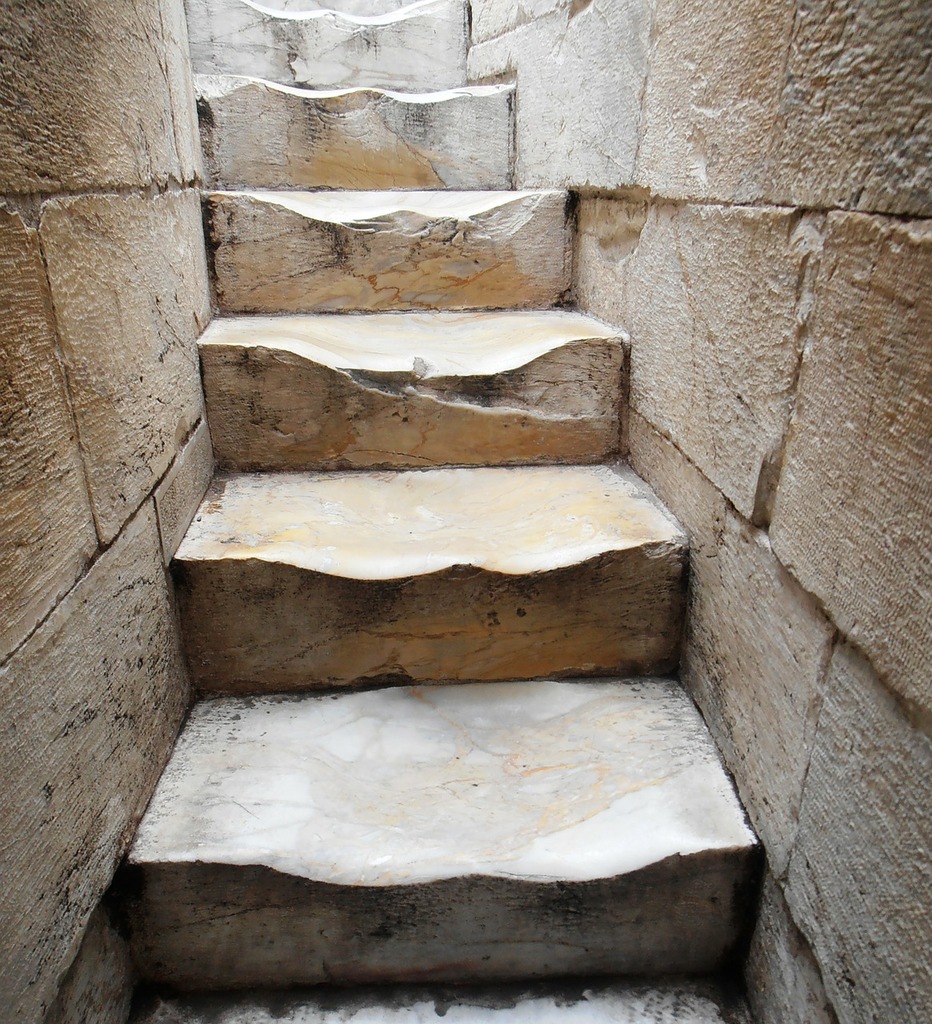
As I’ve aged, I have had the chance to observe how my tendencies become my habits which then becomes my personality. We can become most anything we want but it’s harder to change who we are the longer we repeat our habits. I once thought that aging people lost their polite veneers and simply became more of who they really were. It seemed that they became more honest and forthright about their opinions and emotions. I don’t believe this anymore. My own slow steps into the shade of the future have led me to believe that it’s not their true selves suddenly shining through. Their opinions and emotions are the result of their daily self talk, where they focus, and which memories they choose to enshrine. All in all it’s their habits that make them who they are.
Our habits make up our world. But what makes our habits? When we spend long enough repeating them we form rutted roads in our minds. Neural pathways in our brain are our most used roads. The branches to other parts of the brain’s network fall away from disuse until we are left with our rutted road. One problem with old roads is that there are lesser and lesser numbers of intersections as time passes. Another problem with very old roads is that the road itself sinks below the surrounding area, making it difficult to do anything except follow the road. If you’ve never seen one here’s a great article about some in England. The picture is from the Natchez Trace Parkway in Mississippi USA.
https://www.bbc.com/travel/article/20230813-holloways-englands-mysterious-sunken-roads
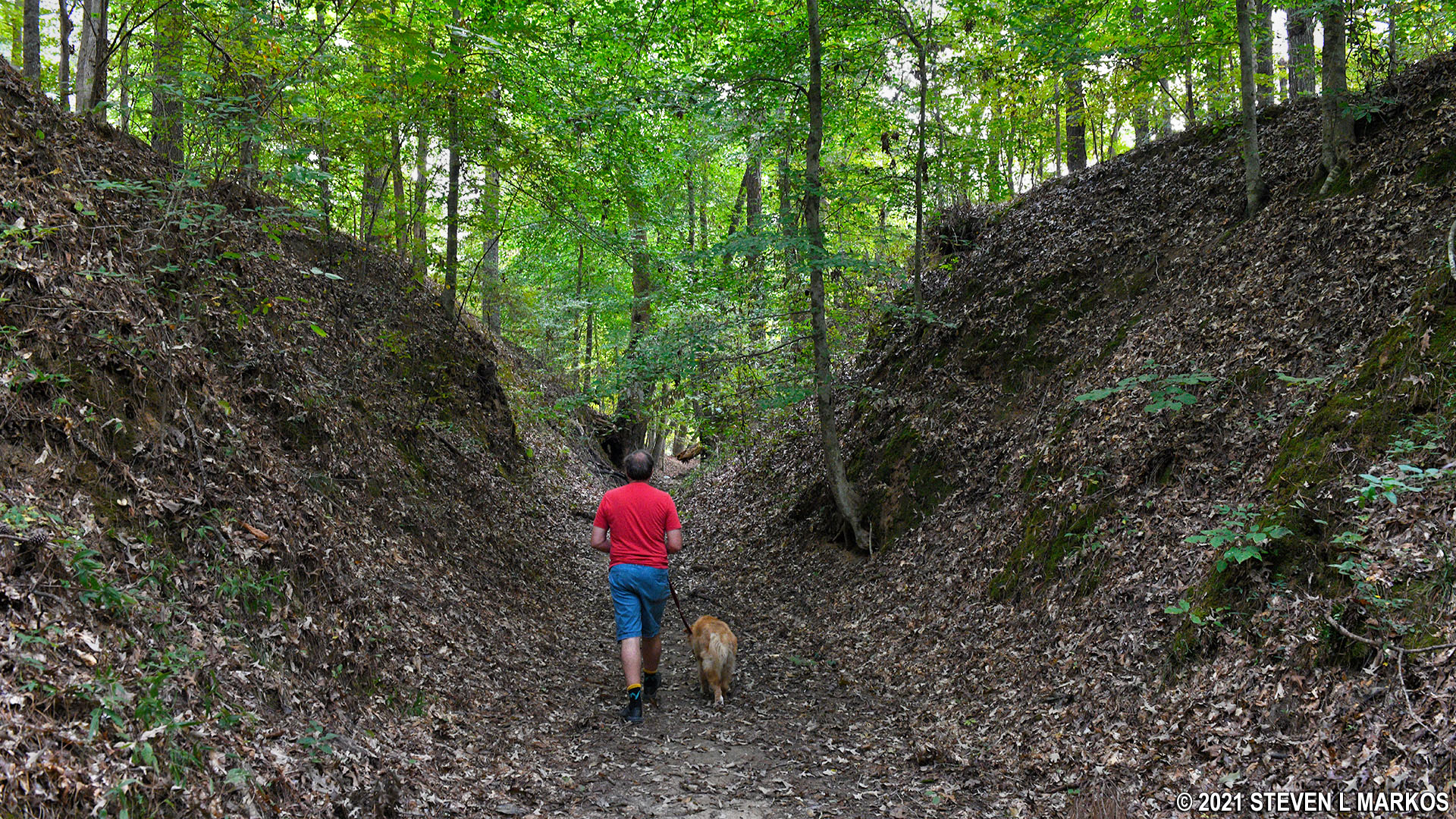
The oldest pathways are the hardest pathways to turn off of or reroute. That would seem to be why so many of the elderly get stuck in their ways.
If a habit was easy to change, or if it didn’t serve us somehow, we wouldn’t keep it. But sometimes we have habits, or beliefs, that involve personal risk in order to change them. One of these I’ve come to see quite often is the habit of ingratitude. It’s fairly easy to live one’s life in ingratitude. It might even be easier than living in gratitude. It’s safer to be ungrateful. We don’t owe anyone anything when we’re not grateful. We can take credit for the good things that come our way and blame the world when things go poorly. There’s no risk when we don’t expect anything from anyone. The golden rule becomes – If I don’t expect anything from anyone then they can’t expect anything from me – which is then used as the basis for an entire philosophy of life. To change this belief would cause one to have to take risks and maybe be sorely disappointed.Most of us prefer safety and hold onto our beliefs whether they’re true or not. We use our self-talk, focus, and selective memories to corroborate what we wish to believe.
Self-talk is just what it sounds like. It is what we tell ourselves about the world around us and what our opinions are about occurrences throughout the day. When we wake up in the morning we can groan and roll over burying our faces in the bedding as if the sunlight were poison before we even think a single thought. But when the brain does kick in we get to choose what we say to ourselves. There’s no need for over exuberance at this point. We can tell ourselves that the day will be awful, but we don’t know that. We can’t truly predict the future at all. If we could the weatherman would be right more often. We could just as easily tell ourselves that the day will be wonderful. Either way we don’t know what the day will bring. But if we spend our entire lifetime telling ourselves just how awful the world is we will make our part of it as awful as we believe it should be. Why? Because we need to be right for no other reason than we’re humans who like to be right.
To be right though, takes work; especially if we’re trying to be right despite contradicting evidence. Here is another branching off point. It’s a fork in the road where the longer we keep taking the same turn, the harder it is to see the other choice. We focus on the things that keep leading us down the same path. If we are determined to see the world as an awful place, we have no need to look any farther than the morning paper, podcast, or news show to keep us feeling aligned with our worldview. We can focus on the worst of the worst stories until we feel comfortable. While we take in the horrible tales of man at his worst, we will gloss over the stories that show our better natures. Some people even belittle positive stories as childish and naive. Approaching reality as though the viewpoint of a cold, uncaring, destructive world is somehow more realistic than a world where both good and bad exist because they need it to be that way.
The older we get, the more likely it is that we will view new information with a bias based on our memories. I’ve been around, but only really paying attention, some 50 odd years. I remember when gasoline was 60 cents a gallon. Well, actually I don’t remember gas being 60 cents per gallon. I remember my father complaining that it was 60 cents a gallon. Was it 60 cents? I really don’t know. So many of us base our views today on memory. That’s not necessarily bad but memories should be verified, just in case. We will probably remember the parts of a situation that reinforce our present ideas. How many of us really remember the adult reality that was happening during our childhoods? We don’t and we can’t remember that because we didn’t live it. At best we’re remembering what our parents, teachers, and mentors said. Many older people remember only parts of their own youth and confabulate those memories to be what all of society experienced, without any variations for age, place, or social status. We romanticize, or in some cases devalue, the past to justify our current belief system.
One of my favorite movies is Midnight in Paris. It’s a movie about how society can look better in the rear view mirror than it did to those who knew it in its heyday.
Cognitive Behavioral Therapy (CBT) attempts to address these ideas. It’s helpful and good to learn for anyone at any age. It’s very easy to overlook our own blind spots – probably why they’re called blind spots. But when we see others and don’t understand where they’re coming from, remembering that it took a lifetime of interactions, experiences, other people’s opinions, and the disjointed nature of memory, to get them where they are might help things make sense a little more. If we want to change ourselves, we must change our habits. To change our habits, we need to change our self-talk and what we focus on. Let the past be the past. The memories of how we think things used to be don’t need to determine how things are today. Today is not a lesser version of living than yesterday. We just don’t really know how things used to be.
.
 The Generosity Project
Leave a comment